Morality has collapsed
And why we should embrace it

The collapse of morality
For most of the last few thousand years, our sense of morality didn’t come from within. It was imposed from the outside, through shared rules, religious codes, and the threat of punishment or promise of reward. A sort of outsourcing of our own intuition, because we aren’t trustworthy beings.
Whether it began with tribal instincts, religion, or Enlightenment thinking, morality served one central purpose: to align people around a shared sense of what is right and wrong. It created order by teaching children how to fit into society’s mold.
But today, that shared moral compass is breaking down.
Why is that?
We no longer live in a world with one dominant narrative. Instead, we inhabit fragmented realities, each person consuming a different feed, shaped by algorithms and cultural bubbles.
This didn’t start yesterday. The collapse of grand narratives, like religion, nationalism, and progress has been underway for over a century. But the internet has supercharged it, giving everyone a personalized worldview.
As a result, modern societies can no longer function as moral monoliths. There is no longer a clear consensus on what’s “common sense”.
Signals of the shift
We’re not just theorizing here, this shift is already unfolding around us. You can spot its early signs in culture, technology, politics, and behavior. Below are some of the most telling signals that the old moral order is eroding and something new, messier, but more authentic is trying to emerge.
Cancel culture is burning out
The collective appetite for public shaming and moral outrage is declining. What once felt like justice now feels like noise, often lacking nuance, due process, or long-term impact.
Universal values don’t feel universal
Documents like the UN Declaration of Human Rights are increasingly seen as Western in origin and scope, reflecting only a subset of cultural worldviews. As global power shifts and pluralism expands, attempts to define a global moral baseline are viewed with skepticism, especially in the Global South.
AI ethics expose our divisions
When we try to encode ethics into AI systems, we hit a wall: whose ethics? What seems fair or just in one culture may be deeply problematic in another.
The moral left is losing ground
Progressive politics often lean on appeals to justice, fairness, and virtue, these arguments now struggle to cut through. In a world saturated with competing truths, morality has less persuasive power than value creation, power, or risk-aversion (read fear). This partly explains the rightward shift in many Western electorates.
Shaming is self-defeating
Shame used to work when society had shared values, but in today’s fractured landscape, it often backfires. People double down, dig in, or seek out like-minded echo chambers. The result is polarization, not progress.
Spirituality is shifting East
There is growing interest in Eastern frameworks that emphasize embodiment, presence, and personal awakening over rule-based morality. Practices like meditation, breath work, or somatic healing prioritize inner alignment rather than external obedience. This suggests a turn from moral authority toward felt experience.
Authority is questioned
Institutional trust is at an all-time low, from governments to science to media. Traditional moral arbiters are seen as compromised, biased, or captured by interests. When people stop believing in referees, they stop playing by the rules.
Conspiracies fill the vacuum
In the absence of trusted narratives, people create their own. Conspiracy theories often emerge not from stupidity, but from moral hunger, the desire for good vs. evil stories in a world that no longer offers clear ones. It’s a re-moralization of chaos.
OK - so now what?
“The old world is dying, and the new world struggles to be born; now is the time of monsters.” — Antonio Gramsci
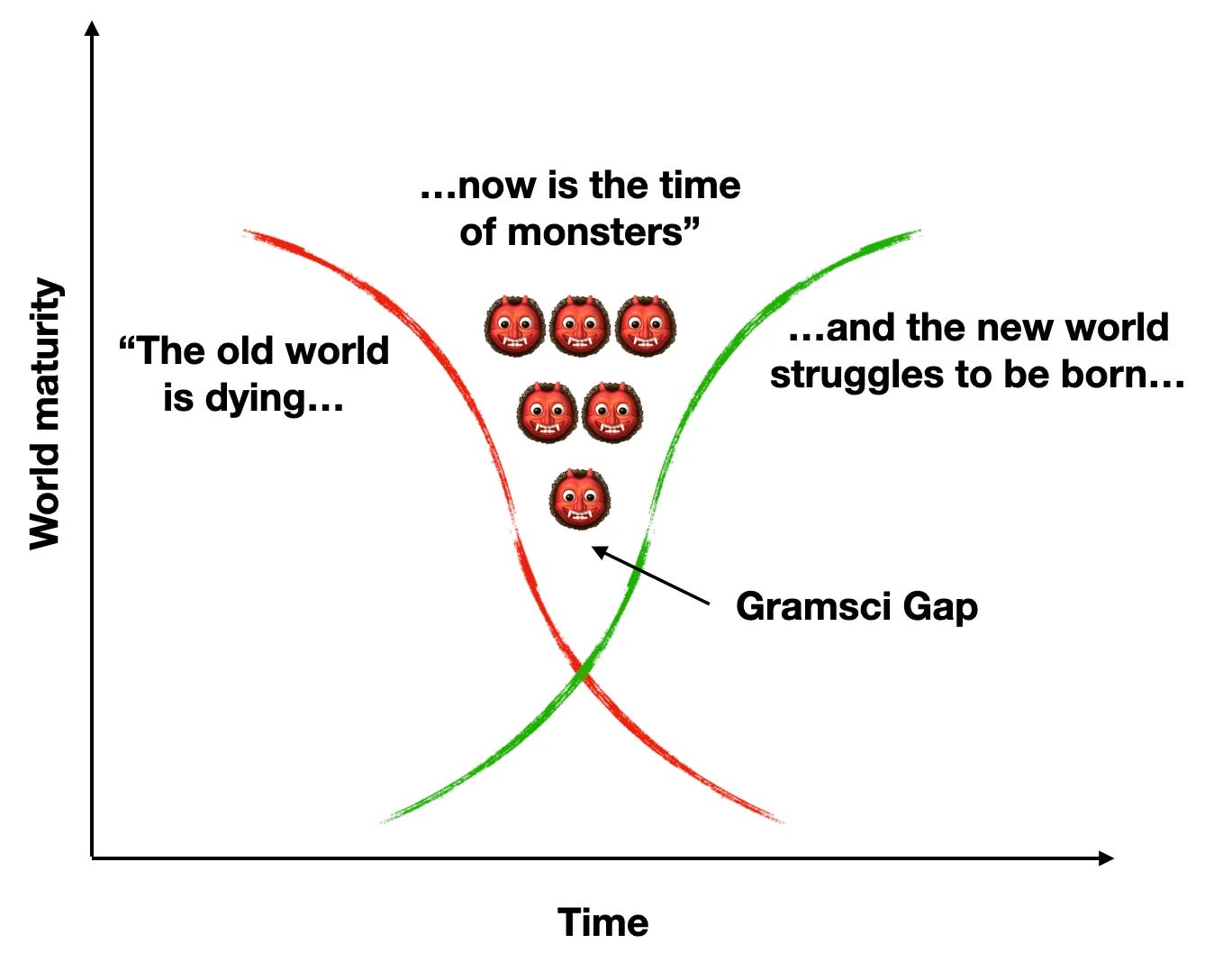
If the old morality has collapsed, what replaces it?
In another piece, I argue we are exiting the Cognitive Era, a period defined by abstraction, rationality, and external authority structures. We built systems where morality was processed like software: rules, logic, categories.
But this requires something we’ve long neglected: reconnection to our own bodies, emotions, and instincts. Many people today are so somatically detached that they no longer know how to discern what’s good or bad outside of social approval.
But that model is breaking down. And here, I want to extend the argument: morality itself is evolving. We’re shifting from consuming morality, through religion, media, schoolbooks, to experiencing it. In the emerging paradigm, morality isn’t something we’re told. It’s something we feel, through intuition, embodiment, and lived experience.
For some, that sounds terrifying. Unstable. Even anarchic.
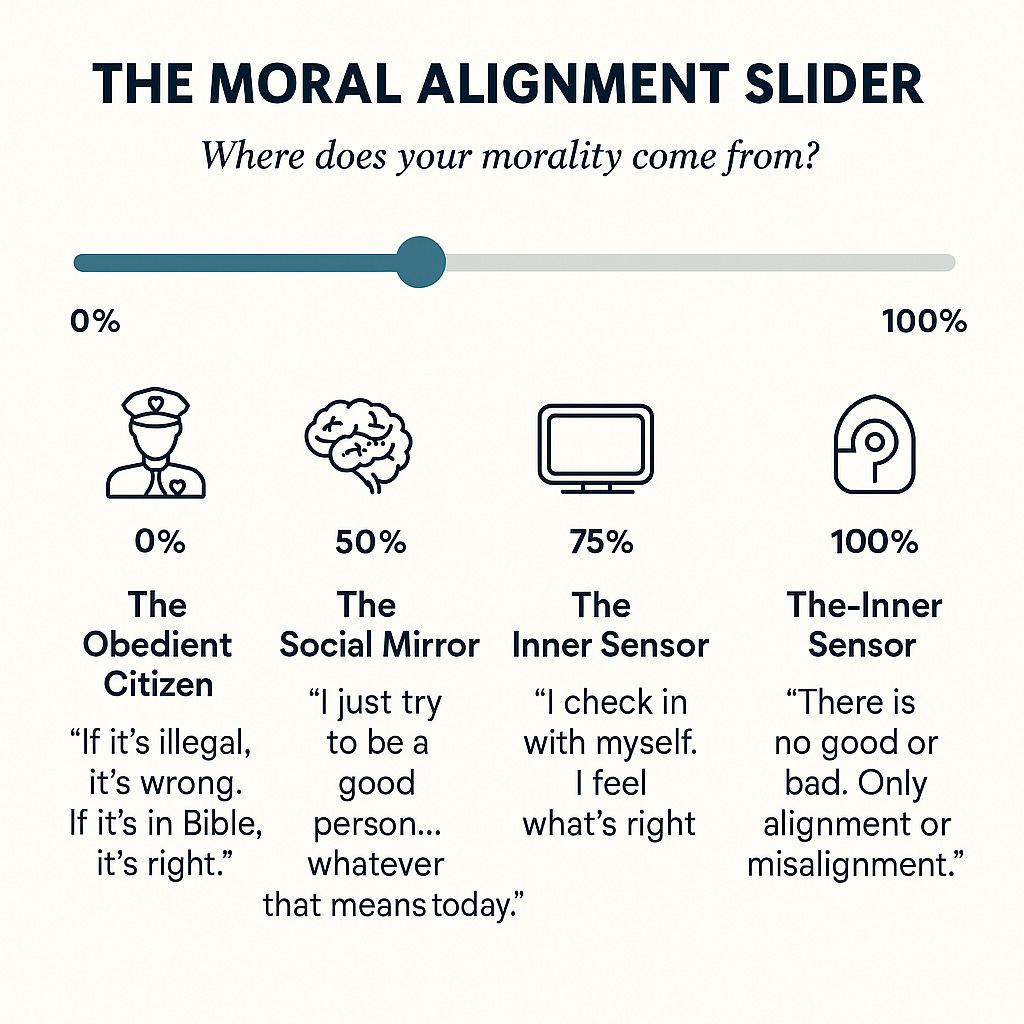
But take a breath. This shift won’t happen overnight. It will be phased, messy and uneven, and many will cling to old frameworks for good reason, they still offer structure in a disorienting world. Traditional morality still has a role to play, especially for those who aren’t ready to cross into the new paradigm. It gives people something to hold onto. And that's OK, for now.
Over time, though, it will recede.
One day, we may look back and wonder how we ever thought rule-based, cognitive morality was the pinnacle of ethics. It will seem mechanical, rigid, and disconnected, a relic of a time when we trusted thought more than felt sense, compliance more than consciousness.
The task ahead isn’t to rip morality out at the roots. It’s to push for an evolution, honoring what it gave us, while allowing something more organic and embodied to grow in its place.