AI will assist the humanities. STEM will assist AI.
Why the pendulum is swinging back, and why the two halves of the workforce will have opposite relationships with machines.

Bring back the humanities baby!
For twenty years the advice was unambiguous: learn to code AND “the humanities are a luxury son”!
The labor data has started telling a different story, HEAL (humanities) jobs are outgrowing STEM (technical) jobs. This is a structural change, and it comes down to one principle: AI automates first whatever it can verify most easily.
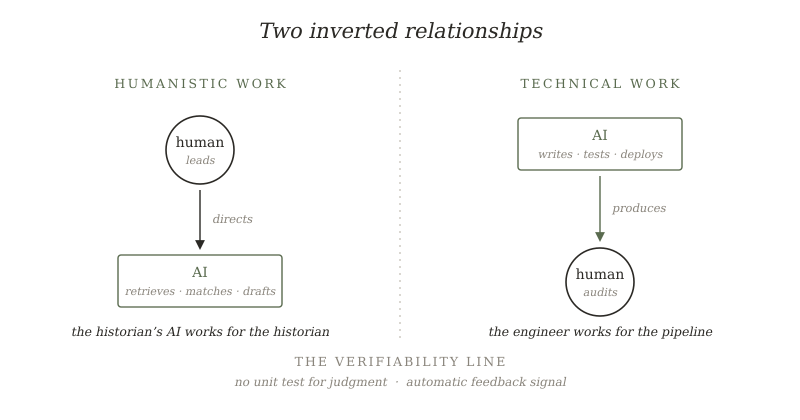
Code compiles or it doesn’t. Tests pass or they fail. Wherever there’s an automatic feedback signal, an agentic system can iterate without a human, and every agentic stack being built today is designed to loop humans out wherever that’s possible. Humanistic work has no such verifier. Whether an argument is honest, whether a decision is wise, whether a long-term strategy is applicable, there is no unit test for judgment. The feedback comes from humans, …..slowly.
So the automation frontier advances along verifiability, how long it takes and how certain you can be of your labelling and how much ground truth data there is out there, and STEM sits on the wrong side of the line.
The result is two inverted relationships with the machine: in humanistic work, AI is instrumentation, retrieval, matching, drafting, while the human leads and owns the meaning. In technical work, the human migrates from author to auditor, supervising and underwriting what the pipeline produces. The historian’s AI works for the historian. The engineer increasingly works for the agent.
Abundance destroys signal
Here’s where it gets interesting though, and where the real economic dislocation happens.
When AI-generated output is something everyone has, it stops signaling anything. There used to be evidence that a capable human spent time on your problem. Now AI-generated stuff is the baseline. The floor rose, and the floor is always equal to mediocrity.
We’ve seen this before. When industrialization made manufactured goods cheap, “handmade” became a luxury claim instead of a default. When recorded music became free, live concerts became the premium product.
The same inversion is underway in ideas. The cost of producing a plausible thought piece, report, or analysis has collapsed to nearly zero. Which means the cost of finding an idea worth reading has exploded. (remember TED’s slogan? “Ideas worth spreading”)
Every fluent, well-cited, structurally impeccable text you encounter now carries a question that didn’t exist five years ago: did anyone actually “originally think” this, or was it regurgitated and repackaged by an AI?
Wrong model: AI as another mind
Which brings us to the mistake almost everyone is making about what AI is in an information ecosystem.
We keep imagining AI as another human-like entity, a synthetic pundit, a tireless analyst, one more voice in the room. Wrong model. The better one comes from a forest: humans are the trees, and AI is the mycorrhizal network, the fungal web connecting the roots.
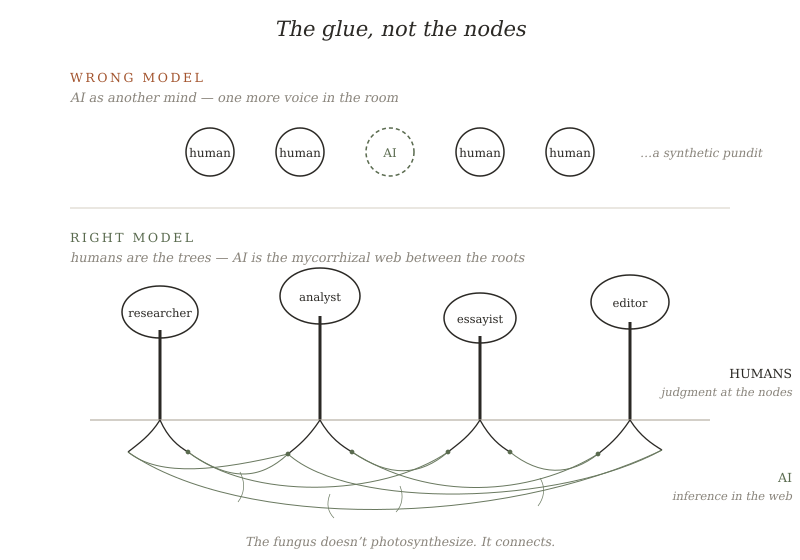
In a forest, the fungus doesn’t photosynthesize. It doesn’t create the energy; the trees do. What the fungus does is connect: it moves nutrients between trees, signals across the forest when one tree is under attack, links organisms that would otherwise never touch. It is indispensable, HOWEVER it is not a tree.
There is an important complementarity between us and it, and right now people see the two as way too overlapping. There is an overlap, but this merely exists as interface to carry out complementary functions.
Anyways, that’s the architecture for curation - The nodes are people: the researcher whose ideas you trust, the thought leader whose calls have aged well, the essayist whose taste keeps proving out. AI is the vector between nodes, not a node, it traces who cites whom, notices when someone you trust starts reading someone you’ve never heard of, distills ideas that are relevant to you, and notices patterns in a sea of human signal. Judgment at the nodes, inference in the web (AI becomes a sort of web between humans in that sense).
Most of what passes for distillation today, superficial feeds, industry monitors, gets this backwards: it treats the machine layer as the source and skims its output. That’s monitoring what happened while ignoring who is actually thinking. As machine coverage floods in, it converges on noise summarizing noise. Too put it bluntly if AI keeps eating its own shit it’ll fall sick.
The forest doesn’t need more fungus pretending to be trees. It needs the web that helps you find the trees worth sitting under. (very poetic, I know..)
Culture flows one way first
The humanities won’t replace STEM, however “humanistic work” (whatever that actually means) becomes a load-bearing pillar of the economy, because of a dependency the fungus metaphor makes obvious: the network is only as alive as its trees.
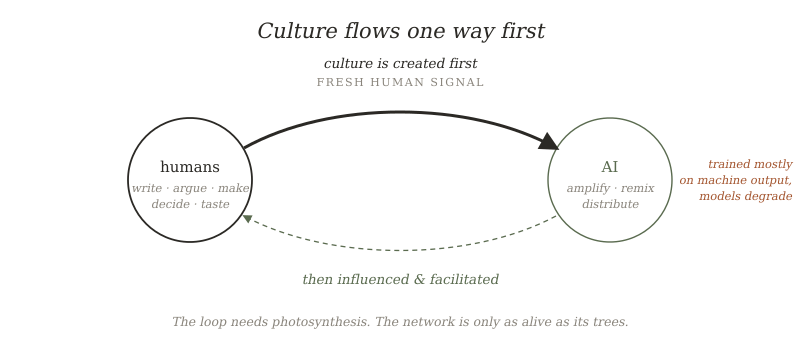
AI must stay in sync with human culture, and culture is created by humans first, then amplified, remixed, and distributed by machines. Models trained mostly on machine output degrade; the loop needs fresh human signal the way a forest needs photosynthesis. The people generating that signal stop being a cultural luxury and become upstream infrastructure, for the economy and for the machines themselves.
For two decades, the machines needed us to do the human parts of technical work. Next, we’ll use them to do the technical parts of human work, and the most human part left is choosing what’s worth our attention.
The humanities aren’t coming back as a luxury. They’re coming back as the job.
cost of finding an idea worth reading has exploded... clap clap clap
This is great. One of the things I’m thinking about it whether you can use LLMs (as fungus) to help increase the speed of feedback/updates by designing interactions better (based on beliefs - mainly beliefs in causal relationships).